Robbery with Violence- The ongoing Chagos Crime

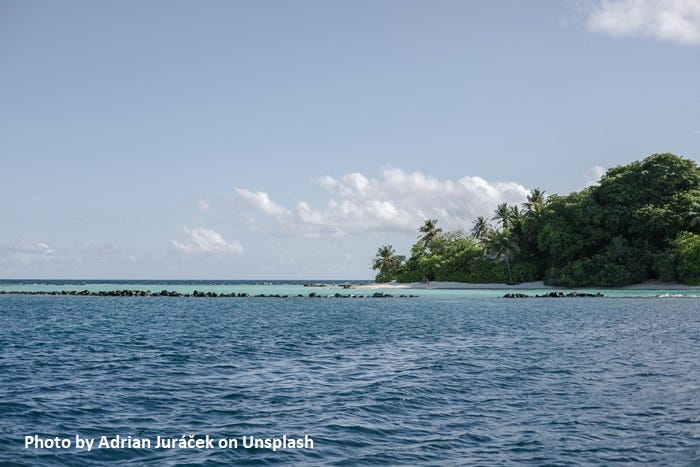
The Chagos story is a perfect case study of key aspects of the UK state. We learn that UK colonialism is alive and well, that it is happy to disregard and crush ordinary people who stand in the way, that racism still informs our so-called foreign policy, that the UK is radically subservient to the US, that it will cheat and lie to give its behaviour a little polish of respectability, and that international law is only observed as and when it is convenient.
The Chagos archipelago is in the Middle of the Indian Ocean, around 900 miles distant from both Mauritius and the Seychelles. It was colonised by the French in 1715 and ceded to the Brits in 1814.
On 22nd May the UK signed up to a deal with Mauritius. The deal recognises Chagos as belonging to Mauritius and each year the UK will pay £103 million to lease the islands so that it can continue to have a military base on the largest island, Diego Garcia. Of course, the base will be the UK’s in name only – the island is a huge unsinkable US aircraft carrier, with the Middle East, Indian sub-continent and the far East in feasible range. It has also been an out-of-sight black-ops destination for “enhanced interrogation”.
UK types suffering from the severe form of empire nostalgia have been sputtering about this abandonment of sovereignty, not quite grasping the fact that the sovereignty has long been abandoned to the US, and that in the Diego Garcia context Mauritian sovereignty has absolutely no meaning. The formal and notional hand-back comes after pressure over the years, culminating in the 2019 ICJ judgment ( and a subsequent UN General Assembly vote) which sided with Mauritius. The UK handed the US access to Diego Garcia in the 1960s as part of a squalid deal giving the UK a discount on a Polaris ICBM missile system. The splutterers are also concerned that the deal puts the US base at risk, giving China more regional sway, showing their utter ignorance of the UK’s complete subservience to the US. Diego Garcia is as likely to be prised from US hands as is Guantanamo Bay, Okinawa or Shannon Airport.
And then there are people. A 1966 Foreign Office communique the islanders reads: “The object of the exercise is to get some rocks which will remain ours; there will be no indigenous population except seagulls who have not yet got a committee. Unfortunately along with the Birds go some few Tarzans or Men Fridays whose origins are obscure, and who are being hopefully wished on to Mauritius etc.” The British colonial machine was as good as its word. - between 1967 and 1973 the indigenous inhabitants were forcibly removed from the islands to make way for the US base and resettled to live in poverty in Mauritius or the Seychelles. In 2016 the UK confirmed that it would not allow them to return to their homeland. The signing of the UK-Mauritius deal was held up by an injunction granted to a Chagossian on the grounds that there had been no consultation with the original inhabitants. Judge Martin Chamberlain dismissed the injunction allowing the handshake to go ahead. The UK has offered citizenship to Chagossians in Mauritius and Britain but has failed to provide any adequate compensation. It is still the wish of many if not most Chagossians to return to their homeland and their forced exile from a homeland they knew as a paradise is still a living pain.. The UK will not permit the return and still fails to accept that it has been and continues to be guilty of a grave breach of international law, that is “ the deportation or forcible transfer of a population”. This is maybe part of the reason that Whitehall is muted in its criticism of Tel Aviv plans to drive out Palestinians from Gaza and the West Bank – the parallel is all too easily drawn. Granted that in both cases toeing the US line is the prime motive.
And there is another dimension – nuclear weapons at Diego Garcia, carried by US B2 bombers. Mauritius has ratified the Pelindaba Treaty which makes Africa a nuclear weapon-free zone. As it now has formal sovereignty it is obliged now to insist that there are no nuclear weapons stored at or deployed from the island. The UK is not a party to the Pelindaba Treaty itself, but it has ratified Protocols I and II. These protocols, signed in 1996, prohibit the use, testing, or assistance with the use of nuclear weapons in the African nuclear-weapon-free zone. So the UK has an obligation to uphold the Treaty in respect of a territory over which they have at least a measure of control and responsibility and must similarly insist that US nuclear weapons are removed.
It is also relevant that although Mauritius has not yet signed or ratified the Treaty on the Prohibition of Nuclear Weapons (TPNW), it has promoted universal adherence to it, including by consistently voting in favour of an annual UN General Assembly resolution since 2018 that calls upon all states to sign, ratify, or accede to it “at the earliest possible date”. If Mauritius wishes to have nuclear weapons removed from its territory its position would be made much stronger by joining the TPNW, whose Article 4 is clear:
“Article 4. Notwithstanding Article 1 (b) and (g), each State Party that has any nuclear weapons or other nuclear explosive devices in its territory or in any place under its jurisdiction or control that are owned, possessed or controlled by another State shall ensure the prompt removal of such weapons, as soon as possible but not later than a deadline to be determined by the first meeting of States Parties.”
An independent Scotland wishing to remove the UK’s nukes must also have that backing, which is why all Scottish politicians who claim to be committed to their removal must be challenged to double down on support for the TPNW.
This shameful and continuing story must be told and retold. The human aspect is well and beautifully described in Florian Grosset’s graphic account: The Chagos Betrayal: How Britain Robbed an Island and Made Its People Disappear.